If you’ve ever searched for a “plant-a-lamp” or a “plant touch lamp,” you probably already know what you’re looking for — a lamp that your plant turns on and off. Not a smart bulb, not a voice assistant, not a sensor bolted to a shelf. You want to touch a leaf and have the light respond. And since 2025 it is possible again.
This section provides an overview of the blog, showcasing a variety of articles, insights, and resources to inform and inspire readers.
The Original Plant Touch Lamp
In the 1970s, a product called the Magic Plantern appeared on store shelves. It was one of those rare inventions that made people stop and ask: how does that actually work?
The concept was simple enough to explain in a sentence — touch the plant, the lamp turns on — but strange enough in practice that it felt like a trick. Guests would spend entire evenings trying to work out the mechanism. Kids thought it was actual magic. Adults weren’t entirely sure it wasn’t.
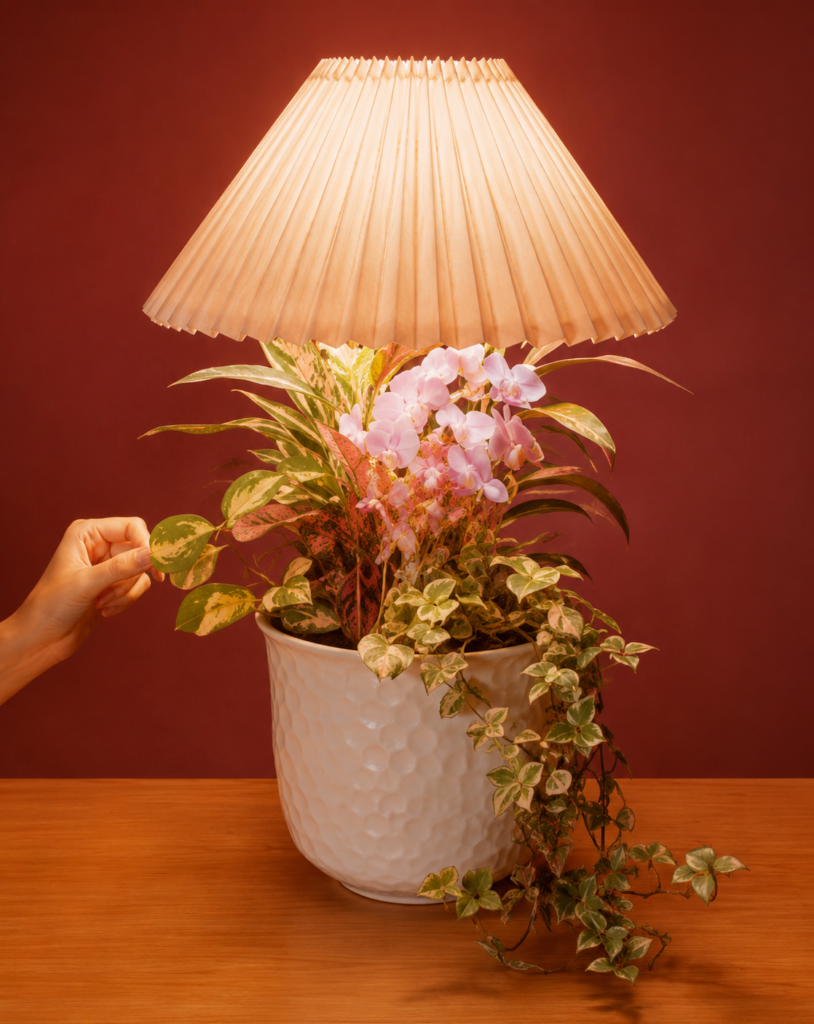
The original Magic Plantern combined a planter with an integrated lamp shade, all built around a touch-sensitive pole buried in the soil. The plant itself — its leaves, its moisture, its living electrical conductivity — completed the circuit. No button, no switch, no remote. Just your hand and a plant.
It was sold in the 70s and 80s, became something of a cult object, and eventually disappeared from production. Today, original units occasionally turn up on Etsy for around $100. Condition varies. Whether the sensor still works is never quite guaranteed.
Plant-a-Lamp: The Pole-Only Revival
For years after the original Magic Plantern faded out, the closest thing available was a product called Plant-a-Lamp — a lamp pole you’d bury in the soil of your own pot, supply your own shade, your own bulb, your own plant. The idea was identical: touch a leaf to switch the light on and off, hold a leaf to dim it.
Plant-a-Lamp kept the concept alive, and it had a following. But it was always a DIY proposition. A bare green pole. Choose your own pot, find a compatible shade, source a dimmable incandescent or LED bulb (CFL won’t work), figure out how tall your plant needs to be for it to reach the leaves. For some people that flexibility was the appeal. For most people it was just friction standing between them and a lamp they wanted.
As of April 2024, Plant-a-Lamp is also out of stock — the manufacturer is developing a new version. If you’re reading this, you can’t buy one right now.
What Magic Plantern Became
We built Magic Plantern as a direct descendant of the original 70s lamp, and of the plant-a-lamp idea more broadly. Same core concept: touch your plant, control your light. But designed from scratch as a complete object, not a pole waiting for a pot.
Here’s what that means in practice:
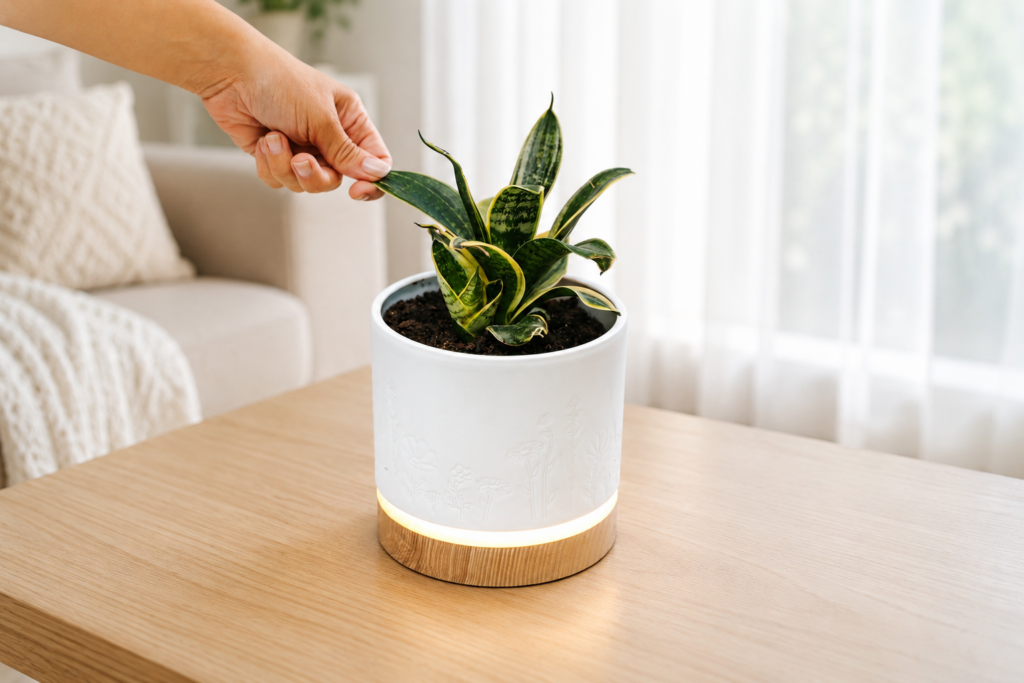
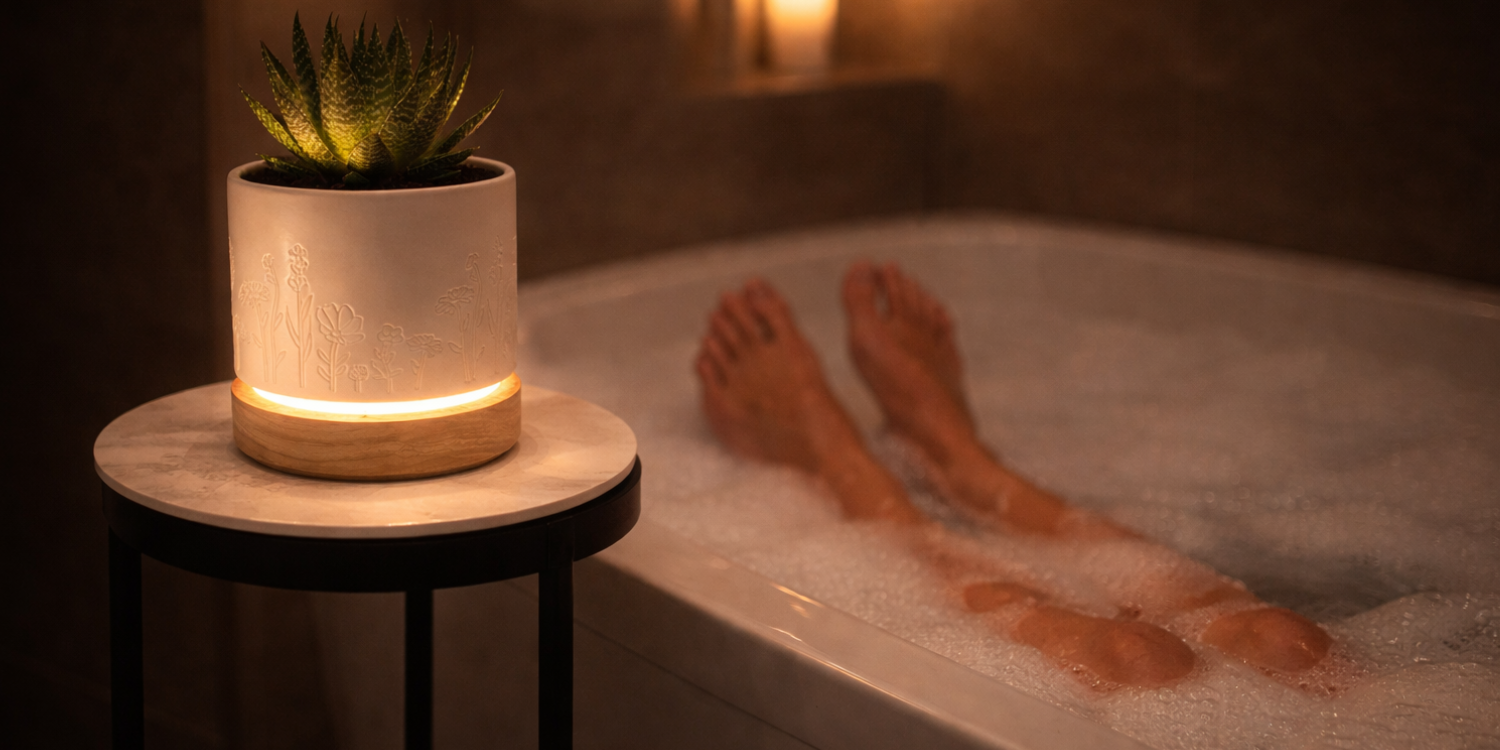
The planter. A matte white ceramic vase with an embossed wildflower pattern, 15 cm across. Sized for succulents and most small houseplants. It looks like an object someone designed, not an object someone assembled.
The base. Solid white ash wood with a warm LED strip built in — 3.6W, 3000K. The light glows upward through the gap between the ceramic and the wood, washing the pot in warm amber. No shade required. No bulb to find.
The sensor. Two antennas go into the root ball of the plant when you pot it up. One touch turns the lamp on. A longer touch dims it smoothly. The plant is genuinely the switch — just like the original, and just like Plant-a-Lamp, but without the DIY assembly.
The watering note. After you water, the lamp may go quiet for 2–3 days while the soil dries. This is normal — when the soil is too wet, conductivity changes and the sensor needs time to recalibrate. Water lightly, and only when the soil is dry.
The specs. 100–240V (works internationally), UL Listed, suitable for damp locations, 2-year limited warranty.
Vintage Planter Lamp vs. Magic Plantern: A Practical Comparison
| Vintage Magic Plantern (1970s) | Plant-a-Lamp | Magic Plantern (now) | |
|---|---|---|---|
| Available to buy | Rarely, Etsy ~$100 | Out of stock | Yes |
| Complete product | Yes | Pole only | Yes |
| Bulb/shade needed | Yes | Yes | No |
| LED compatible | Unknown | Yes | Yes, built in |
| Dimming | Yes | Yes | Yes |
| Design | Vintage, varied | DIY | Modern ceramic + wood |
| International | Unknown | USA only | Yes (100–240V) |
| Warranty | None | 2 years | 2 years |
The Best Plants to Use
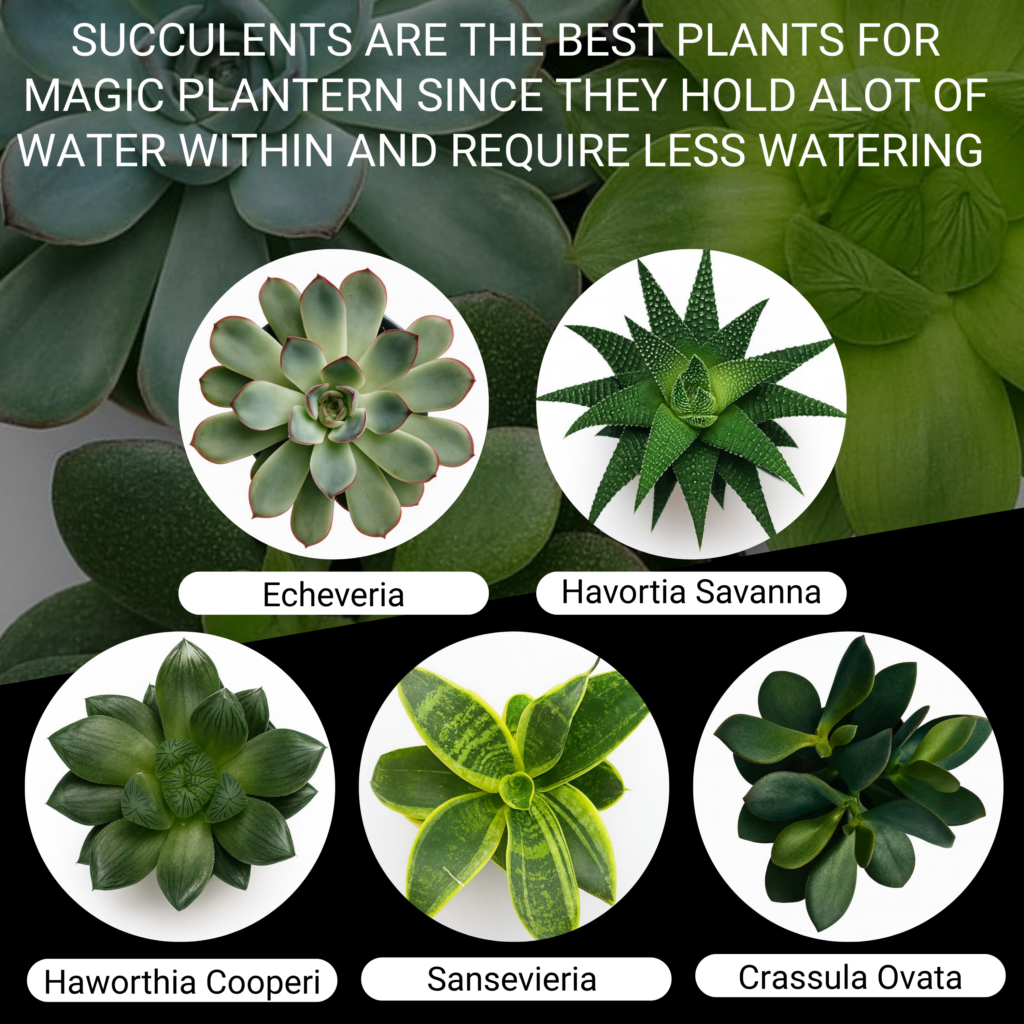
For the most reliable touch sensitivity, succulents work best — they’re hardy, need little water, and their conductivity is well-suited to the sensor. Good options include Echeveria, Haworthia, Sansevieria, Haworthia Cooperi, and Crassula Ovata. That said, many small houseplants will work fine. Experiment.
One plant that almost always surprises people: Pothos. Trails beautifully over the edge of the ceramic, leaves everywhere to touch.
The Idea Hasn’t Changed
Fifty years after someone first buried a touch-sensitive pole in a pot of soil and watched people’s faces, the thing that makes a plant touch lamp interesting is still exactly what it was: it’s not a gadget, it’s a moment. Someone walks into a room, touches a leaf, the light comes on, and they look at you like you have some explaining to do.
That’s worth designing something around.
Magic Plantern is available at themagicplantern.com.
-
Plant-a-Lamp: The Idea That Never Got Old (And What It Became)
If you’ve ever searched for a “plant-a-lamp” or a “plant touch lamp,” you probably already…
-
Magic Plantern – Bathroom Mood Lighting Ideas — How To Create A Spa At Home
Overhead lights are practical. They help you find your toothbrush and check if your eyeliner…

No responses yet